Back in 1997
I was so excited about alignment that I sent out letters to ski schools across France to share my ideas with other professionals. I thought some, at least, would reply and that the benefits of proper alignment would begin to be more broadly appreciated. None of the ski schools responded. However, the director of one school showed my letter to Michel Gros, a member of Rossignol’s racing department. From my mail shot the only call I received was from Michel of Rossignol.
Michel invited me to Austria that year to diagnose the alignment of Rossignol’s sponsored racers. Rossignol’s main interest was to find out if I could do something about the abnormally poor performance of their star racer Jure Kosir since he had switched to Rossignol boots.
Jure Kosir was an outstanding racer
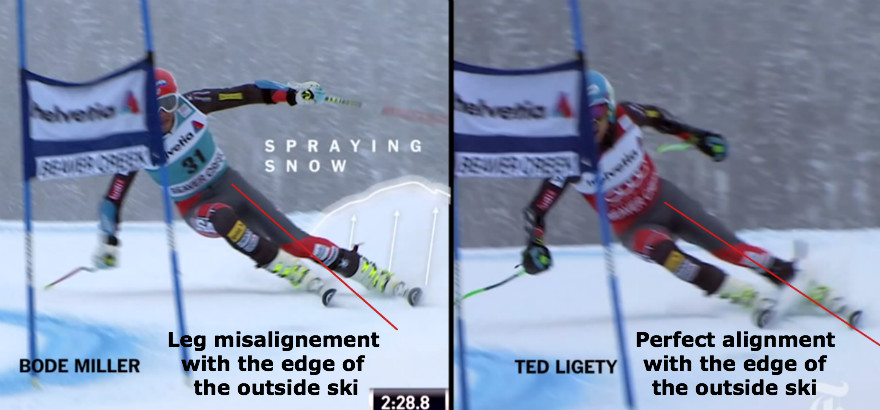
He had been number two in world cup ratings in slalom until he changed his make of ski boots. For sponsorship reasons, Jure, who had been racing on Nordica boots, had switched to Rossignol boots. In doing so he dropped from second to twenty first place in the world cup rankings. Somehow the good anatomical synergy that existed between Jure and his Nordica boots was broken once he was in Rossignol boots. I diagnosed him to be over-canted – he had to pull his knees out to have his feet flat on the snow. The next day we had him ski with and without adjustments with the astonishing, but not surprising, gain of 70/100 of a second advantage after alignment on a 33 second course. To put this in perspective, this advantage, over a world cup course, would be the difference between coming first or nowhere.
Results
Intrigued by the results, Michel took me to the Rossignol factory where I saw how race boots are made and what sort of tinkering goes on to tweak them. What I learned at Rossignol was that the mould used to press the melted plastic into shape can be adjusted to give the boot more or less of a built-in edge angle. Jure Kosir’s boots were built with more edge angle than he had previously had on his Nordicas and, as a result, his skiing had deteriorated. Rossignol’s empirical thinking was to give their racers more edge angle hoping to get more speed out of them, but in Jure Kosir’s case the adjustment was too great.
Even in a major ski company like Rossignol, tweaking racers’ boots is still based on black art formulas based on beliefs that the industry has not questioned for eons. No laser scan assessment, no biomechanical assessment, no muscle test – only age old empirical hit and miss procedures. I gave Michel the specific angle adjustments needed to be made to Jure’s boots for him to consistently ski with 70/100 gains and that is all that I ever did with Rossignol aside from having a few dinners with them now and again.